
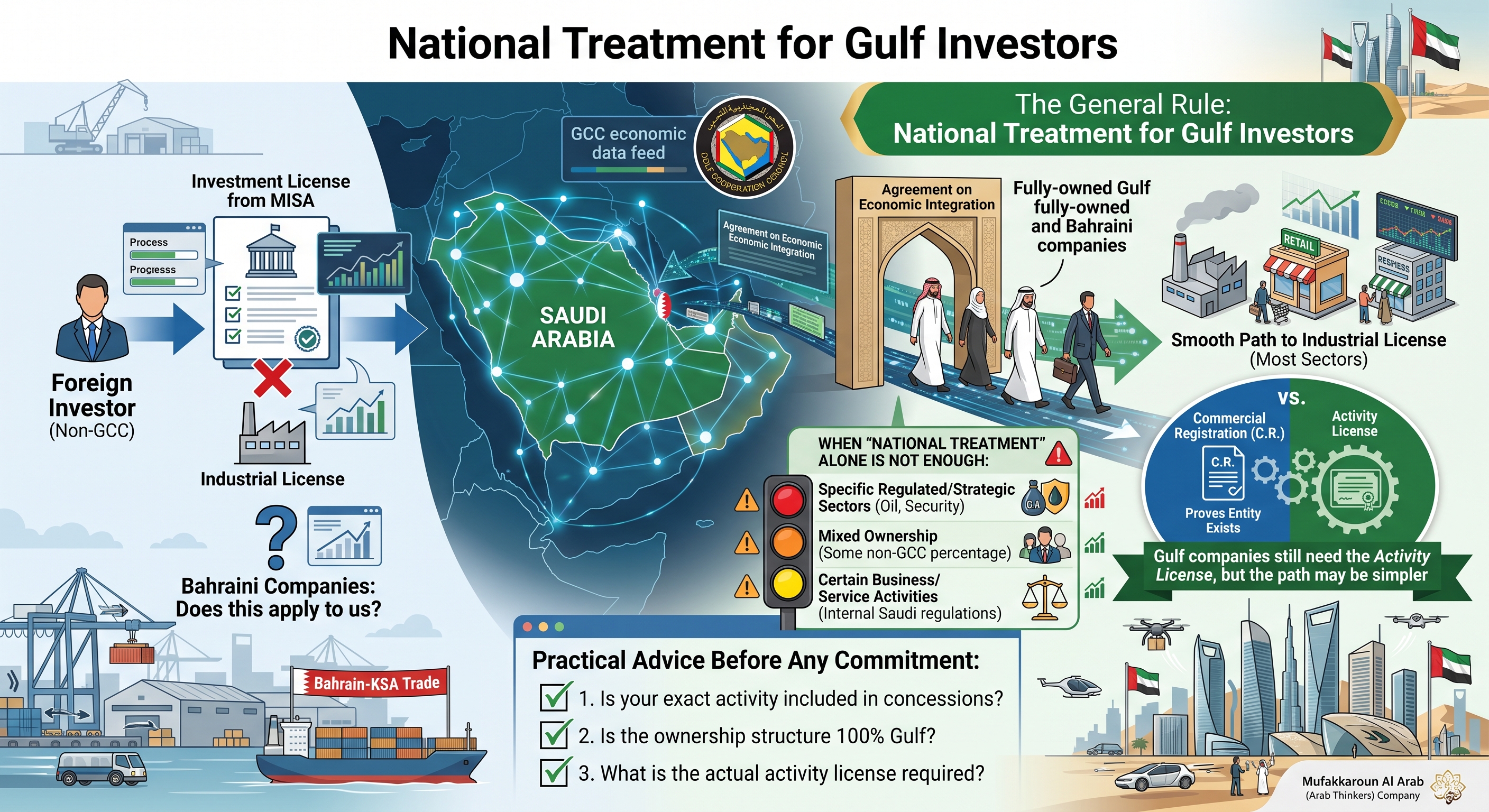
We previously wrote about industrial licensing in Saudi Arabia, and mentioned that "a non-Saudi investor needs an investment license from the Ministry of Investment (MISA) before the industrial license itself." That single sentence was enough to bring questions from Bahraini companies: "We're Gulf nationals, not foreigners — does the same thing apply to us?"
It's a fair question, and the answer isn't a simple yes or no — which is exactly why it deserves its own article.
The general rule: national treatment for GCC investors
Under the GCC Economic Agreement, citizens of Gulf Cooperation Council states and companies wholly owned by them are granted treatment close to that of Saudi nationals across many economic activities — a principle that has been firmly in place for years as part of GCC economic integration.
In practice, this means a Bahraini company fully owned by Bahraini or other GCC nationals may not need to go through the full "foreign investment license" path that a non-GCC investor follows, in many sectors.
Notice the wording: "in many sectors," not "in every sector." That's precisely what a GCC investor needs to verify before building a plan on an assumption.
When "national treatment" alone isn't enough
National treatment is a general principle, not a blanket automatic exemption from every procedure. There are cases where an extra step remains necessary, or where the application differs:
- Regulated or strategically sensitive sectors, where specific licensing requirements may remain regardless of the investor's nationality
- Mixed ownership — if the company structure includes even a small share held by a non-GCC partner, the classification may change entirely
- Certain commercial and service activities governed by separate internal Saudi regulations distinct from the foreign investment framework itself
The practical lesson: don't assume. The exact ownership percentage and the specific activity — not GCC nationality alone — are what settle the answer.
Commercial registration is not an investment license
A recurring point of confusion, similar to what we explained earlier about SABER and industrial licensing: Commercial Registration (CR) establishes that a legal entity exists and is registered. An activity license (industrial, commercial, or service) establishes that this entity is authorised to carry out a specific activity. Even a company benefiting from GCC national treatment usually still needs the appropriate activity license for its work — the difference is that the path to obtaining it may be simpler than for a non-GCC investor, not that it disappears entirely.
Our practical advice
Before any commitment — leasing a site, signing a contract, requesting a quote for equipment — verify three things specific to your case:
- Is your particular activity classified among those covered by national-treatment facilitation?
- Is the ownership structure entirely GCC, or does it include any non-GCC share?
- What is the actual license required for your specific activity, once the nationality question is set aside?
Your entire setup plan is built on these three answers, and a wrong assumption in any one of them means repeating a full procedure later.
How we help
At Arab Thinkers Co, we start by assessing the actual reality of your project — the activity, the ownership structure, and the realistic path forward — before any formal procedure, as part of our management consulting and feasibility study services. We then connect that assessment to whatever tax and zakat compliance your project needs, and to SABER certification if your activity involves importing or exporting products.
Before you assume, talk to us.
Reach us on WhatsApp: +973 3831 7525
Need help with this?
Talk to our team — the first consultation carries no obligation.