
Most small business owners choose accounting software the same way: they ask a friend, adopt whatever their accountant uses, or buy the cheapest option. A year later they discover the software will not produce the report they need, does not meet tax requirements, or that moving their data out of it has become a nightmare.
This guide offers a different approach: start from what you actually need, not from a feature list.
Start with one question: what do you want to know about your business?
Before looking at any product, write down the questions you cannot answer quickly today. Common examples:
- How much did I actually make this month after all expenses?
- Which customers are overdue, and how much do they owe in total?
- What does one unit really cost me after shipping and customs?
- How much stock has been sitting unsold for more than six months?
The right software is the one that answers your questions. Any product offering a hundred reports you will never open is the wrong product, whatever its reputation.
The three categories — and which suits you
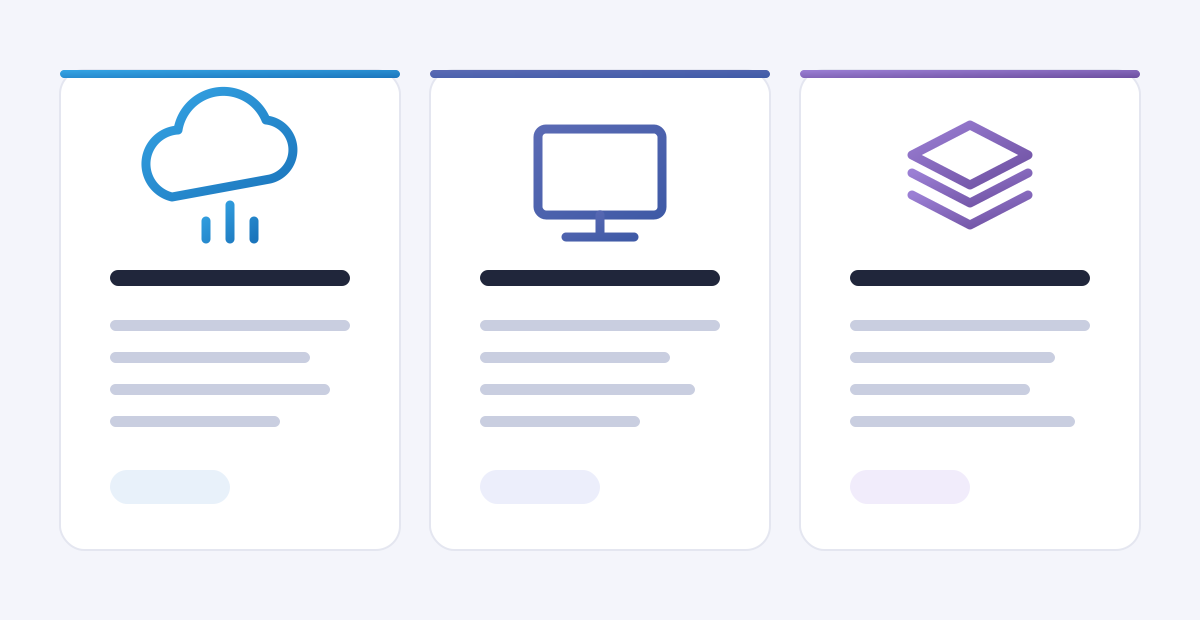
There are three main categories, and each has a situation where it wins:
- Cloud software: runs in the browser on a monthly subscription. Best for small and medium businesses: no server needed, automatic updates, access from anywhere. The trade-offs are ongoing payments and dependence on a stable connection.
- On-premise software: bought once and installed on a machine or server in your office. Suits owners who want full control of their data or work with weak connectivity. But backups and maintenance are on you, and upgrades usually cost extra.
- ERP systems: go beyond accounting to connect inventory, sales, purchasing and HR in one system. Right for a company whose operations have multiplied and who now moves data by hand between separate tools.
A practical rule: if your team is under ten people with simple operations, cloud software is usually enough. If you are entering the same invoice in three different places, it is time to consider an integrated system.
Seven practical selection criteria
- Tax compliance: does it support VAT in Bahrain and the GCC and produce filing reports in an acceptable format? This is not a bonus feature, it is a baseline requirement.
- E-invoicing: if you deal with the Saudi market, check that the software keeps pace with e-invoicing requirements there.
- Arabic support: not just a translated interface, but invoices and reports that print correctly in Arabic.
- Multi-currency: essential if you import or export, and it should handle exchange differences automatically.
- Getting your data out: ask before you buy — how do I export everything if I decide to move later? A vague answer is a warning sign.
- Permissions: can you stop an employee from seeing profits or editing a posted entry? This matters as the team grows.
- Support: in which language, during which hours, and how quickly? Excellent software with absent support equals bad software.
Four mistakes that force a second selection
- Buying on price alone. The gap between fifty and a hundred dinars a month is not measured in price but in the hours lost working around what the cheaper option cannot do.
- Ignoring whoever will use it daily. If it is too complex for your staff, they will quietly return to spreadsheets and the whole benefit disappears.
- Skipping proper data migration. Start the financial year with correct opening balances, or every report afterwards is questionable.
- Switching on every module at once. Begin with accounting and invoicing, master them, then add inventory and payroll in turn.
How to test before you commit
Most products offer a trial. Do not settle for watching a demo — enter one month of your real company data: actual invoices, actual expenses. Then run the reports and compare them against what you already know about that month.
This short exercise reveals in a week what a year of sales presentations may never show.
Where we help
At Arab Thinkers we start by analysing your actual operations before recommending any system, because what suits a contracting company differs from what suits a retail shop. Then we handle implementation: configuration, migrating your historical data with correct balances, training your team, and follow-up after go-live.
We also provide financial and tax consulting aligned with Bahrain and GCC regulations, so you end up with both a working system and clean books.
If you are considering new accounting software, or struggling with a system that is not serving you, message us on WhatsApp with your line of business and team size. We will suggest the most suitable option honestly — even if that turns out to be keeping what you have with a few adjustments.
Need help with this?
Talk to our team — the first consultation carries no obligation.