
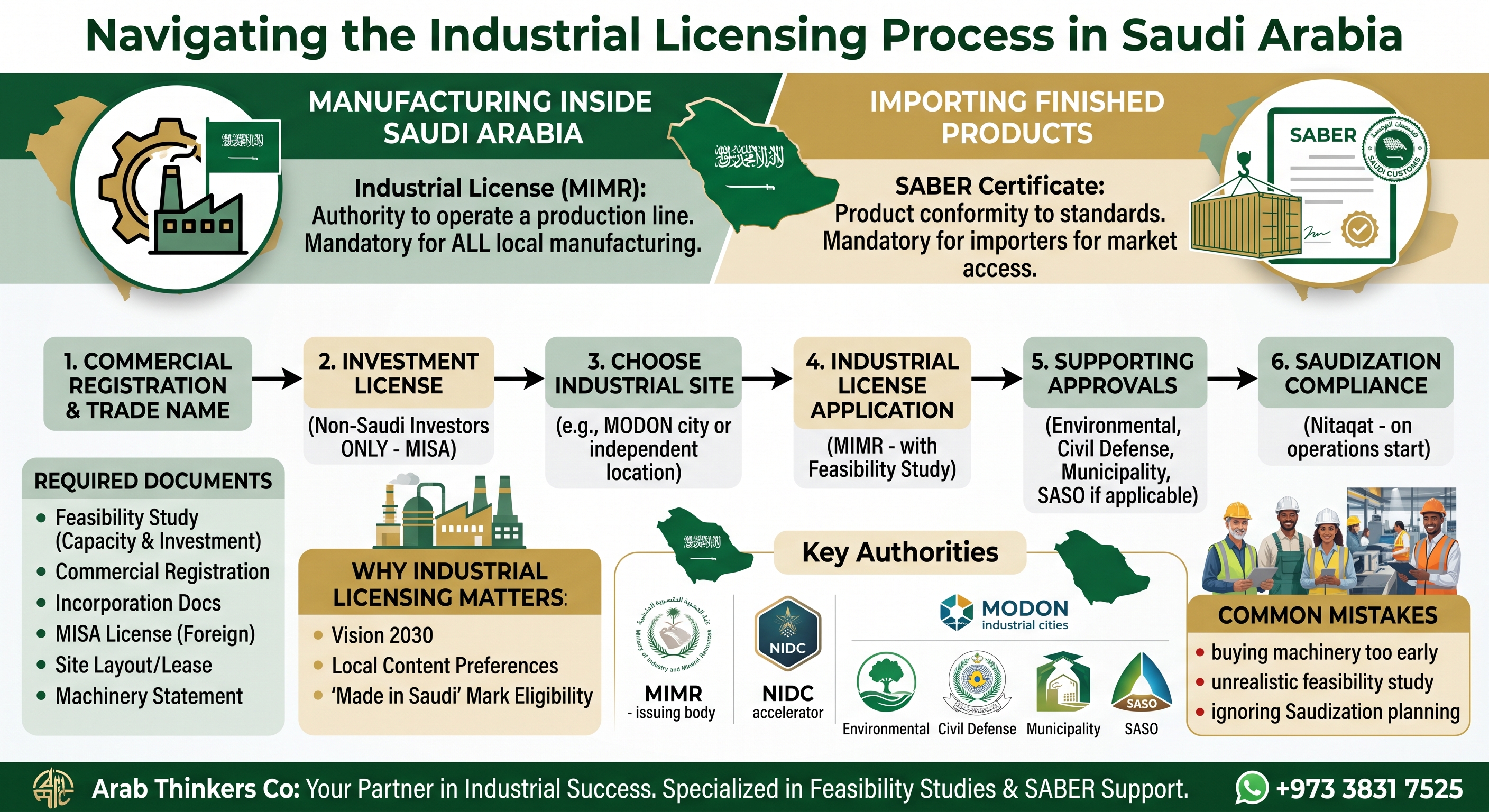
Anyone planning to set up a manufacturing plant in Saudi Arabia — whether a new facility or relocating an existing production line — faces one question before any other: do you hold an industrial license?
This license is entirely different from a SABER certificate. SABER applies to anyone importing a finished product to sell in the Saudi market.
An industrial license applies to anyone who wants to manufacture inside Saudi Arabia itself — without it, no production line can legally operate, regardless of product quality or investment size.
Why industrial licensing matters more now
Saudi policy is pushing firmly toward local manufacturing under Vision 2030: local-content preference programs in government contracts, and the "Made in Saudi" mark, open doors in tenders that a fully imported product cannot reach.
A company holding a valid industrial license isn't just operating legally — it becomes eligible for these programs.
Who needs an industrial license
Any establishment carrying out genuine manufacturing activity inside Saudi Arabia — converting raw or semi-finished materials into a final or intermediate product — regardless of the facility's size or headcount.
This does not include companies that simply import a finished product for resale (that falls under SABER), or businesses providing a service with no actual manufacturing involved.
Non-Saudi investors need one additional step before the industrial license itself: an investment license from the Ministry of Investment of Saudi Arabia (MISA), which establishes the legal standing for foreign investment before applying for any activity-specific license.
The authority in charge
The primary body issuing industrial licenses is the Ministry of Industry and Mineral Resources.
Depending on the project, several other bodies come into play:
- The National Industrial Development Center (NIDC) — works to streamline and accelerate licensing procedures under Vision 2030 initiatives
- The Saudi Authority for Industrial Cities and Technology Zones (MODON) — for facilities located inside a designated industrial city
- The General Authority of Meteorology and Environmental Protection, Civil Defense, and the relevant municipality — for site- and safety-related approvals that typically follow
It's common for a single facility to be dealing with more than one of these bodies at the same time — this is one of the most common sources of confusion for first-time investors in the system.
The general path to an industrial license
The exact order can shift slightly depending on the activity and the facility's location, but the overall structure stays consistent:
- Reserve the trade name and obtain the Commercial Registration (CR)
- Obtain an investment license from the Ministry of Investment (non-Saudi investors only)
- Decide on the industrial site — inside a MODON-managed industrial city, or an independent location requiring separate municipal and environmental approvals
- Submit the industrial license application to the Ministry of Industry and Mineral Resources, including a description of the activity and the planned production capacity
- Complete supporting approvals: Civil Defense, environmental clearance, municipality, and — where the final product falls under a technical regulation — the Saudi Standards, Metrology and Quality Organization (SASO)
- Align the facility with Saudization (Nitaqat) requirements once actual operations begin
Documents typically required
- A feasibility study covering planned production capacity and investment
- Commercial Registration and the company's incorporation documents
- The investment license (for foreign investors)
- Site layout plans or the industrial land lease agreement
- A statement of machinery and equipment and their source
The feasibility study in particular is not a formality — it determines the licensed production capacity going forward, and any later change to it means an additional administrative procedure. Getting it right the first time saves considerable time down the line.
Industrial license vs. SABER — the most common confusion
Many Gulf companies that started by importing into Saudi Arabia, then decided to manufacture locally, assume their industrial license covers SABER too — or the reverse. The reality:
- SABER applies to anyone bringing a finished product into the Saudi market, whether manufactured locally or imported from abroad
- The industrial license governs the right to operate the production line itself inside Saudi Arabia
A locally licensed factory may still need a SABER certificate of conformity for its finished product if that product falls under a technical regulation — the two licenses work together, not as substitutes for one another.
Common mistakes that delay licensing
- Buying machinery or leasing a site before confirming the activity is permitted at that specific location
- A feasibility study built on unrealistic production capacity, discovered only once operations begin
- Dealing with the Ministry of Industry alone while the site actually requires a separate environmental or municipal approval that wasn't requested in time
- Postponing Saudization planning until after operations start, instead of building it into the licensing stage
How we help
At Arab Thinkers Co, we build industrial feasibility studies from the ground up — production capacity, capital cost, and financial viability: the document the licensing application itself is built on. We also support financial planning and tax and zakat compliance after incorporation, and where your project involves importing components or exporting the finished product, we prepare and submit every requirement needed to obtain the SABER certificates involved.
Before you lease a site or request a quote for a single machine, talk to us.
Reach us on WhatsApp: +973 3831 7525
Need help with this?
Talk to our team — the first consultation carries no obligation.